Tax Diversification for High-Income Earners: How to Reduce Lifetime Taxes (Not Just This Year)
Tax Diversification for High Earners: Why Reducing Taxes Today Isn’t Enough
If you’re earning $400,000+ a year, you’ve probably been told:
“Just reduce your taxable income this year.”
Max your 401(k).
Take the deduction.
Move on.
That works… in the short term.
But here’s the issue.
You can do everything “right”—
earn well, save aggressively, invest consistently—
…and still build a massive tax problem for your future self.
Because when most high earners build wealth, they don’t build control.
They build concentration in one tax bucket.
“If you’d rather watch this, I break it down step-by-step here.”
Now let’s walk through it.
What Is Tax Diversification (And Why Does It Matter)?
Tax diversification means:
Spreading your wealth across different tax buckets so you can control how and when you pay taxes.
Not avoid taxes.
Control them.
Because here’s the reality:
If most of your wealth is in one place—especially pre-tax—
You’re not in control.
The IRS is.
The Real Problem: You Built Wealth… But Not Flexibility
Let’s make this simple.
Think about your finances like a thermostat.
Too hot → you turn it down
Too cold → you turn it up
Small adjustments. Easy control.
Now compare that to having:
Three space heaters… plugged into one outlet.
That’s what happens when all your money is in pre-tax accounts.
Withdrawals stack
Social Security stacks
Investment income stacks
And suddenly:
You’re not choosing your tax bracket.
You’re reacting to it.
Ideally, you are building a lifetime tax plan
Additionally, read how How High-Income Earners Should Reduce Taxes (Without Creating a Future Tax Problem)
The 3 Tax Buckets Every High Earner Needs
1. Pre-Tax Accounts (401k, Traditional IRA)
This is where most high earners default.
You get a deduction today
It grows tax-deferred
You pay taxes later
Sounds efficient.
And it is.
But here’s the catch:
Every dollar you withdraw is taxed as ordinary income.
This isn’t fully your money.
It’s a partnership with the IRS.
And you don’t control their future rate.
2. Roth Accounts (Roth 401k, Backdoor Roth)
This is the only bucket that removes uncertainty.
You pay taxes now
It grows tax-free
Withdrawals are tax-free
Once money is in a Roth:
The IRS is done with it.
No guessing. No future tax exposure.
Roth isn’t about saving taxes today.
It’s about buying certainty.
3. Taxable Brokerage (Most Underrated Bucket)
This is where high earners often hesitate.
But it’s one of the most valuable tools you have.
No upfront deduction
Capital gains treatment
Full flexibility
You control:
When to sell
When gains show up
How income is recognized
This bucket doesn’t avoid taxes.
It lets you manage them.
Real Example: Same Income, Completely Different Outcomes
Let’s make this real.
Two households:
Both earn $350k+
Same savings rate
Same discipline
Same investment returns
After 20 years:
→ Both end up around $4 million
So on paper?
They look identical.
But this is where the difference shows up.
Household A: All Pre-Tax (The Default Path)
~$2.2M in pre-tax
~$1.6M in brokerage
Looks solid.
But here’s what’s actually happening under the surface.
That $2.2M?
Every dollar is taxed as ordinary income when it comes out.
Not capital gains.
Not a lower rate.
Ordinary income.
Now layer in reality:
Required Minimum Distributions start
Social Security gets added
Withdrawals stack on top of each other
And suddenly:
They’re not choosing their tax bracket anymore.
They’re being pushed into it.
What That Actually Looks Like
Let’s say:
They need $150k–$200k/year in retirement
Sounds reasonable.
But if most of that comes from pre-tax accounts:
→ That entire amount is taxable income
Now add:
Social Security
Portfolio income
And it’s very easy to end up:
→ Right back in high tax brackets
Even in retirement.
The Real Cost
Over time, that $2.2M:
→ Can easily generate $400k–$600k+ in lifetime taxes
And remember:
They only saved about $147k in taxes upfront.
That’s the trade.
Household B: Tax Diversified (Intentional Strategy)
~$1.1M Roth
~$1.1M pre-tax
~$1.6M brokerage
Same total wealth.
But completely different control.
What This Looks Like in Real Life
Now when they need income:
They don’t have one option.
They have choices.
They can:
Pull from pre-tax → fill lower tax brackets
Pull from brokerage → manage capital gains
Pull from Roth → add income without increasing taxes
So instead of:
→ “What do we owe?”
The question becomes:
→ “How do we want to structure income this year?”
Why This Matters More Than It Sounds
This isn’t about saving a few percentage points.
This is about:
Avoiding forced income from RMDs
Managing Medicare premium thresholds
Controlling how Social Security is taxed
Reducing lifetime tax exposure
And just as important:
Reducing stress around every withdrawal decision.
The Real Difference
Both households built wealth.
Only one built control over that wealth.
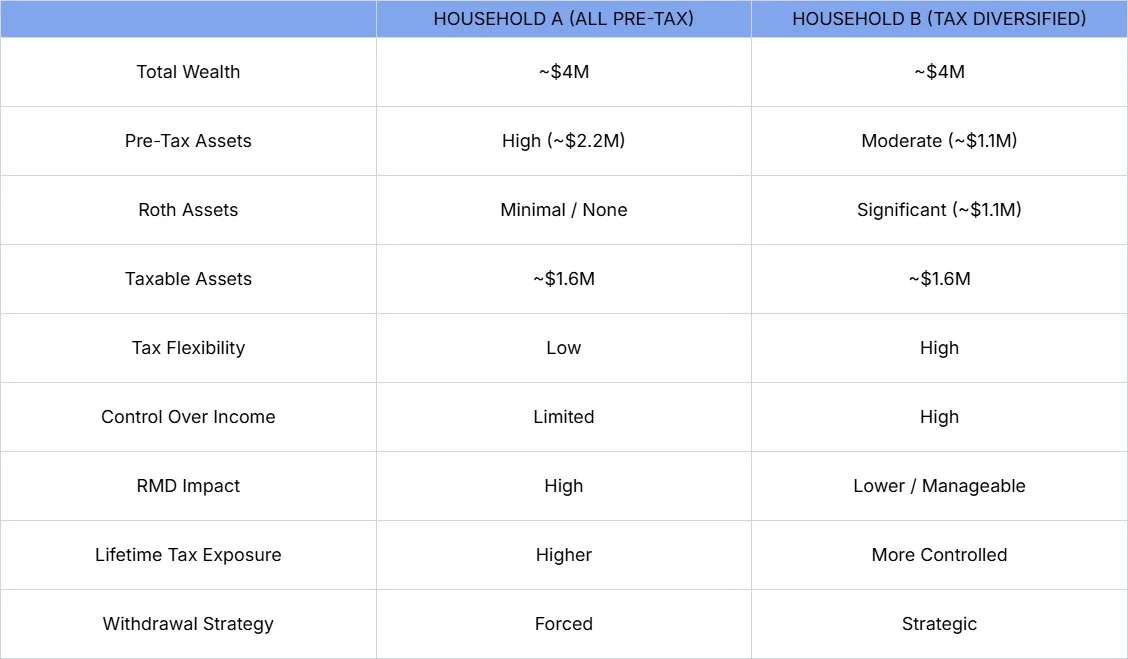
Both households built wealth. Only one built control over that wealth.
The Hidden Cost of “Just Maxing Pre-Tax”
This is where high earners get stuck.
They think:
“I’m saving 35% on taxes right now.”
True.
But zoom out.
You’re trading:
A known tax rate today
For:
An unknown tax rate later
And if most of your wealth is pre-tax:
You don’t control that outcome.
Why Tax Diversification Creates Control (Not Just Savings)
This is the shift.
When you have all three buckets:
You can:
Pull from Roth → no tax impact
Pull from brokerage → manage gains
Pull from pre-tax → fill lower brackets
Now:
You choose your tax bracket.
That’s the difference.
Why This Matters Even More for $400k+ Earners
At your income level:
Small mistakes don’t stay small
Timing matters more
Taxes compound just like investments
And your income sources are more complex:
Bonuses
RSUs
Options
Variable comp
Without tax diversification:
You’re stacking income on top of income.
Every year.
The Strategies Everyone Talks About (That Don’t Work Without This)
You’ll hear about:
Roth conversions
Backdoor Roth
Tax loss harvesting
Charitable strategies
All of these are useful.
But here’s the truth:
They only work if you have multiple buckets.
If everything is pre-tax:
You don’t have a strategy.
You have a limitation.
Where Most High Earners Get This Wrong
Most people:
Focus on this year
Chase deductions
Max pre-tax without thinking long-term
They’re optimizing a single year.
Not designing a lifetime.
A Simple Way to Start Fixing This
You don’t need to overhaul everything.
Start with awareness:
What % of your net worth is pre-tax?
What % is Roth?
What % is taxable?
If the answer is:
“Almost all pre-tax”
That’s your signal.
Final Thought: This Is About Control, Not Just Taxes
This isn’t about avoiding taxes.
It’s about:
Controlling when and how you pay them.
Because over 30–40 years:
Timing matters more than almost anything else.
If You Want Help Structuring This Around Your Situation
If you’re earning $400k+ and thinking:
“Alright… I’ve been doing this, but I haven’t really looked at it this way.”
That’s normal.
This is where things start to matter more.
I offer a free 60-minute equity and tax review where we:
Break down your current tax exposure
Look at how your buckets are structured
Identify where you may be over-concentrated
And help you think through what to adjust next.